Showing posts with label Afro-America. Show all posts

Sunday, April 29, 2007

Miles underground

A strange quote from the 1989 autobiography of the great jazz legend Miles Dewey Davis III:
I did some weird shit back in those days, too many weird things to describe. But I’ll tell you a couple. I remember one day when I was really paranoid from snorting [cocaine] and staying up all the time. I was driving my Ferrari up West End Avenue and I passed these police-men sitting in a patrol car. They knew me - all of them knew me in my neighbourhood - so they spoke to me. When I got about two blocks away from them, I became paranoid and thought that there was a conspiracy to get me, bust me for some drugs. I look down in the compartment on the door and see this white powder. I never took coke out of the house with me. It’s winter and snowing and some snow got inside the car. But I didn’t realise that; I thought it was some coke that someone had planted in the car just so I could get busted. I panicked, stopped the car in the middle of the street, ran into a building on West End Avenue, looked for the doorman, but he wasn’t there. I ran to the elevator and got on and went up to the seventh floor and hid in the trash room. I stayed up there for hours with my Ferrari parked in the middle of West End Avenue with the keys in it. After a while I came to my senses. The car was still sitting where I had left it.
I did that another time just like that and a woman was on the elevator. I thought that I was still in my Ferrari, so I told her, “Bitch, what are you doing in my goddamn car!” And then I slapped her and ran out of the building. That’s the kind of weird sick shit that a lot of drugs will make you do. She called the police and they arrested me and put me in the nut ward at Roosevelt Hospital for a few days before letting me out“.

From 1975 until 1980, Davis was a self-confessed hermit, living without any meaningful contact with the outside world. He spent his days drinking Heineken and brandy, and taking heroin, cocaine, or injecting speedballs into his legs. A speedball is the lethal combination of cocaine and heroin that killed John Belushi and River Phoenix. Davis also says he “fucked all the women I could get into my house” (p. 325). And through it all, he never once picked up his horn throughout more than four years.

Monday, March 05, 2007

Cab Calloway chooses music over the Harlem Globetrotters

This YouTube thing is addictive. Just found a very short clip of the great basketball player Kareem Abdul-Jabbar talking about music legend Cab Calloway. It seems that Calloway was actually a pro basketball player after playing bball in high school. In the 1920s, he was selected to play with the Harlem Globetrotters, but decided instead to tour with his band. He also played baseball against Dizzy Gillespie - the great jazz trumpeter.

Kareem Abdul-Jabbar won a national championship in college and then went on to win 6 NBA championships for two teams, and played professionally for 20 YEARS!!!
He also was one of the pilots in the film Airplane, and fought against Bruce Lee in Game of Death. He was born as Lew Alcindor, but changed his name because of his conversion to Islam. Advice from fellow students from Muslim countries led to his avoiding the US Black Muslim movement, the Nation of Islam, whose ranks had once included Malcolm X. In this interview, Abdul-Jabbar talks about what he calls the "totalitarian" version of Islam that underpinned the September the 11th attacks.
20-July-2007: I've just noticed that YouTube have removed this video due to an alleged violation of its terms of use. Not sure what that's about...

Sunday, March 04, 2007

Independent news from African-American Los Angeles

After covering a story down the street, a Hood News reporter shoots footage of the LAPD shooting at a homeless man who was running away from them. The police tried to stop Hood News from filming and argued with the reporter.

I came across this after watching a message from the stars of the NBA to the youth of the urban ghettos of the US. A few black basketball stars who had grown up in the hood had some words for these African-American communities. In this other Hood News video, the crew also try to interview the young star LeBron James and are snubbed. The crew dismiss James as 'Hollywood' when he refuses an interview. The reporter said that James was refusing to address a "community in poverty, and up and coming youth" as LeBron James stood behind him, and then called to James to give a shout out on Hood News, but was totally ignored as James got into his car. The reporter reckoned he was on a "solo mission" and it was "a disappointment to the black culture, and minorities". See also details of LeBron's dance-off defeat, below.

Thursday, February 15, 2007

Miles Davis

I've just been listening to the first great Miles Davis Quintet. In the 1950s they recorded some classic jazz albums including the quartet Workin', Steamin', Relaxin', and Cookin'. On saxaphone was none other than John Coltrane, and the rhythm section was Miles' close friend 'Philly' Joe Jones on drums, Paul Chambers on bass, and on piano, the great touch of Red Garland.


Here is an excellent online biography of Miles Davis.

Sunday, January 21, 2007

Remember, folks - always do the right thing


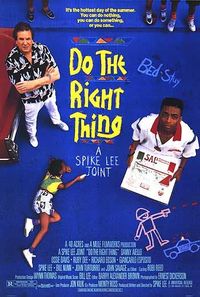
If there’s one film I know inside out, back to front, and upside down, it is Spike Lee’s Do the Right Thing. It’s a film I’ve watched many times. Spike Lee directed, wrote, produced, and starred in the film. It’s a film about a day in the life of a neighbourhood called Beford-Stuyvesant (known as Bed-Stuy) in Brooklyn, New York city. It’s a black neighbourhood, and race is a central theme of the film. The action is a montage of scenes in the life of the neighbourhood, all of which take place on an extremely hot summer’s day. With the oppressive heat as a backdrop, tension builds up within the community as the day unfolds, and the pressure leads to an explosion of action at the end of the film.

The film opens with footage of Rosie Perez doing some provocative, assertive dancing to the beat of Public Enemy’s Fight the Power, from their album Fear of a Black Planet. I used to love Public Enemy when I was a youngster – still do, I suppose. I’m a big fan of Spike Lee as well. I actually wrote my undergraduate dissertation on Spike Lee’s films. It wasn’t much of a dissertation to be honest – my supervisor called me an ‘underachiever’, which was pretty accurate.

A lot of the action in Do the Right Thing centres on an Italian-American business in the heart of the black community. Spike Lee’s himself plays the protagonist, Mookie, who delivers pizza’s for ‘Sal’s Famous Pizzeria’. Sal has a ‘Wall of Fame’ in the pizzeria made up of photographs of prominent Italian-Americans such as Al Pacino. One of the locals (called ‘Buggin’ Out’) takes exception to this, and demands some photos of African-Americans be put up on the wall. This leads to a series of confrontations that drive the action.

Giancarlo Esposito


Buggin’ Out is played by one of my own favourite actors, Giancarlo Esposito. He’s one of those guys who you’d recognise but probably couldn’t have identified if I hadn’t put a photo of him into this post. Off the top of my head, he’s also played Muhammed Ali’s dad in Ali (with Will Smith), and a cop in The Usual Suspects, but he’s been in loads of other stuff, usually playing character roles. He’s also been in a number of Spike Lee films. For my money, he’s one of the most versatile actors around these days. He’s played some hugely diverse roles in his career.

For me, the strength of Do the Right Thing is in its willingness to tackle identity politics head-on. I reckon it gives a very convincing picture of the complexity and diversity of racial issues, but I’m not going to try and capture that at the moment – to do justice to the film and the subject, I’d have to put a bit more time into it than I’ve got just now…

I will just say that the film partly represents a conflict between the philosophies of Martin Luther King Jr. and Malcolm X, two prominent African-American leaders who were assassinated during the 1960s. Whereas Dr. King advocated non-violence, Malcolm X asserted the right of African-Americans in the US to rely on self-help to defend themselves against brutality. The film ends with a quote from each man, outlining his own take on whether the use of force is ever justified. Dr. King’s take on things was that violence is “immoral and impractical” as a solution, as it breeds hatred, and ensures that the cycle of violence will continue. The Malcolm X quote refers to who had the power in US society, bringing us back to the Public Enemy song that features so prominently in the film. Malcolm X believed that the problem of racism was so urgent and so systematic in the US that the black community should employ any means that were necessary to bring it to an end. Spike Lee juxtaposes these competing understandings, and challenges the viewer to reconcile them with the practical realities of Do the Right Thing.

I know exactly what side I’m on. I’ve read Malcolm X’s Autobiography three times and I find his take on things pretty compelling. I think this film is actually what brought me into contact with Malcolm X’s life and thought. I’m no pacifist, and I agree with Malcolm X that for black Americans, when the US government consistently failed to do enough to protect them, self-defence should not be described as ‘violence’ but as ‘intelligence’. Malcolm X spoke in the context of a US where white supremacist attacks on African-Americans went unpunished. This was a culture of impunity for the death of 4 black girls in the bombing of a Birmingham church, and for the assassination of Medgar Evers, an official of the NAACP (National Association for the Advancement of Coloured People). Evers was immortalised in Bob Dylan’s Only a Pawn in their Game, and his assassin was only convicted in 1994 because he boasted of the murder at a KKK rally.

Do the Right Thing also stars Ossie Davis, the man who gave the eulogy at Malcolm X’s funeral, and one thing he said strikes me as quite important at this stage. He draws attention to the fact that Malcolm X had never been personally involved in any violence or disturbance. It was only a case of articulating a policy of self-reliance for a community who were the constant victim of savage attack. It seems reasonable in this context that they would take action to protect themselves and their communities.

Anyway, I got a DVD copy of Do the Right Thing at Christmas, and I’ve just watched the first 40 minutes or so of it. I’ve interrupted my viewing because I promised myself I’d try and improve my blogging frequency in 2007. Anyway, it’s a beautifully shot film, which is given a reflective edge by a lot of long takes and a pleasant jazz score by Spike’s dad, Bill Lee. In other places it becomes much more confrontational, such as in a famous scene (reprised somewhat in Lee’s The 25th Hour). A number of characters take turns addressing the camera with a string of targeted racial abuse. In turn, Puerto Rican, Italian, black, Korean and other characters vent a string of racial invectives against different groups such as Jews or Asians, such as John Turtorro’s rant against blacks which begins: “You gold-teeth, gold-chain wearing, fried chicken and biscuit-eating, monkey-ape-baboon” etc.

It’s an ensemble piece, with a lot of small roles by actors who have since become pretty well known, such as Jon Savage, Samuel L Jackson and Martin Lawrence. A lot of people reckon that all of Spike Lee’s films are about race, which is refuted by films like Summer of Sam and recently, Inside Man. He's a gifted filmmaker and shouldn't be reduced to nothing but an idealogue. But Do the Right Thing certainly has race up front and centre, and gets my vote as one of the best cinematic reflections on racial politics ever made.


Friday, June 02, 2006

Fattening Frogs? What?

The title Fattening Frogs for Snakes refers to a song by the great blues harmonica player, Sonny Boy Williamson II.


Sonny Boy Williamson II


Sonny Boy Williamson II was one of the key figures in the history of the blues. He was born Rice Miller, but stole the name Sonny Boy Williamson from another harp player of the time ('blues harp' or just plain 'harp'=blues slang term for harmonica). They are now known respectively as Sonny Boy Williamson I and II. It is a reasonably regular moniker, in a musical genre characterised by lots of strange names. Some of my favourite blues names off the top of my head include Pinetop Perkins, Blind Lemon Jefferson, Lightnin’ Slim and Taj Mahal (who I managed to see live with his Phantom Blues Band - brilliant stuff).

Like many other of the great blues icons, there is a certain amount of confusion about when Sonny Boy II was born. I have even heard that he lied about the year of his birth in order to get the drop on Sonny Boy I in his claim to the name. Sonny Boy II was from Mississippi, and was a virtuoso on the harp. It’s rumoured that he could play with no hands, by inserting the entire harmonica into his mouth or holding it between his top lip and his nose.

One thing that’s interesting about old-time blues lyrics is the way it seems to be the men that are persecuted rather than the women. Blues songs are populated by women who walk all over the long suffering bluesmen, going out late and not coming back home, spending all their man's money, and evicting them from their own homes in the freezing cold (see the Sonny Boy Williamson II track ‘Nine Below Zero’). A good example of this is Sonny Boy’s classic song, ‘Help Me’, which has become a harmonica standard, in which he pleads for help with the housework (seriously):

I may have to wash
I may have to sew
I may have to cook
I might mop the floor
But you help me babe
I can’t do it all by myself
You know if you don't help me darling
I'll find myself somebody else

I was in Bruxelles once when the Mary Stokes Band was playing, and I was very proud of myself when they agreed to play a request of ‘Help Me’. They had just rejected another couple of calls for requests, but I obviously fooled them into thinking I was a blues purist. Then they proceeded to blow me away with a great version of the song. They had the last laugh when I bought their CD.

The song title ‘Fattening Frogs for Snakes’ seemingly refers to an old American proverb about putting loads of energy into something and not reaping the benefits. If you spend ages fattening up a frog with lots of delicacies, and then a big snake slips into his cage and eats him, you’ve pretty much wasted loads of your time and effort. If I had a penny for every frog I lost this way...

My research on Google tells me that ‘Fattening Frogs For Snakes’ was used as the title of a book about the old blues musicians by a fellow called John Sinclair. He compares the years of musical craftsmanship of the Delta blues musicians to fattening frogs for snakes. According to his take on things, these (mostly African American) blues men and women spent years honing their craft, and then suddenly all these white musicians swooped in in the 60s and had huge success by appropriating blues music.

So, the fatted frog was eaten by the snake-like new wave of British musicians – people such as Eric Clapton, John Mayall, The Animals and The Rolling Stones. There’s no doubt that these guys are true fans of the blues, but they did make it big by ripping off the blues stylings of pioneers like Muddy Waters, Chuck Berry and Howlin’ Wolf. Lots of these guys died in misery and poverty (although there are plenty more like BB King who got plenty of recognition).

Anyway, that’s the source of my blog title - just in case it seemed a little esoteric…