Showing posts with label music. Show all posts

Sunday, April 29, 2007

Miles underground

A strange quote from the 1989 autobiography of the great jazz legend Miles Dewey Davis III:
I did some weird shit back in those days, too many weird things to describe. But I’ll tell you a couple. I remember one day when I was really paranoid from snorting [cocaine] and staying up all the time. I was driving my Ferrari up West End Avenue and I passed these police-men sitting in a patrol car. They knew me - all of them knew me in my neighbourhood - so they spoke to me. When I got about two blocks away from them, I became paranoid and thought that there was a conspiracy to get me, bust me for some drugs. I look down in the compartment on the door and see this white powder. I never took coke out of the house with me. It’s winter and snowing and some snow got inside the car. But I didn’t realise that; I thought it was some coke that someone had planted in the car just so I could get busted. I panicked, stopped the car in the middle of the street, ran into a building on West End Avenue, looked for the doorman, but he wasn’t there. I ran to the elevator and got on and went up to the seventh floor and hid in the trash room. I stayed up there for hours with my Ferrari parked in the middle of West End Avenue with the keys in it. After a while I came to my senses. The car was still sitting where I had left it.
I did that another time just like that and a woman was on the elevator. I thought that I was still in my Ferrari, so I told her, “Bitch, what are you doing in my goddamn car!” And then I slapped her and ran out of the building. That’s the kind of weird sick shit that a lot of drugs will make you do. She called the police and they arrested me and put me in the nut ward at Roosevelt Hospital for a few days before letting me out“.

From 1975 until 1980, Davis was a self-confessed hermit, living without any meaningful contact with the outside world. He spent his days drinking Heineken and brandy, and taking heroin, cocaine, or injecting speedballs into his legs. A speedball is the lethal combination of cocaine and heroin that killed John Belushi and River Phoenix. Davis also says he “fucked all the women I could get into my house” (p. 325). And through it all, he never once picked up his horn throughout more than four years.

Monday, April 09, 2007

Reem Kelani

This is a review of a Reem Kelani gig I saw at a festival last August. Reem Kelani is a Palestinian singer who sings a mix of songs from Palestine and the Palestinian Diaspora. Her father comes from Jenin, and her mother from Nazareth. She has an incredible vocal range, and her vocal style incorporates Arabic chanting and ululations as well as conventional singing. I really enjoyed this music, which was a new kind of sound for me, as it’s not a style of music I’m familiar with. As well as loving the music in its own right, the concert was interesting because Kelani talked quite a bit about the origins and meanings of many of the songs.

There seemed to be a certain formlessness to some of the music, which left a lot of freedom for the different musicians to breathe within the structure of the songs. Kelani on vocals was backed by a bass clarinet, Egyptian violin, drums, and double bass (which was both plucked and played with a bow), but the first number was backed only with syncopated handclaps. This first song was a wedding song from Acre on the Mediterranean, and is about the bride taking the mickey out of her new husband’s family. Her family are saying that they will make their new son-in-law a shepherd or an Arabian king depending on how he treats their daughter. The song is in 6/4 time, which is a very old Palestinian rhythm, apparently.

Next was a song from Gallilee originating from the period of Ottoman rule. It is a slow, sad song, sung by the women when the men are going off to fight in a war. The music is based around a drone in E flat, I think it was – this was the tonic, and Kelani invited the audience to hum the tonic. The singing is in the tradition of the Greek orthodox church, and comes from the influence of Byzantine chanting.

The next song was about a group of women crossing the desert who are refused a lift by a convoy of caravans. They show their resilience by singing to the drivers. The tempo here was a bit faster, with the percussion more in the foreground, with Kelani playing a kind of bodhrán. She clearly still has a love and enthusiasm for this music. It was clear that she was enjoying herself on stage, dancing and communicating with her sidemen.

The next song was the highlight of the concert for me. It was called ‘Baker’s Dozen’ because of the time signature, which is a cycle of thirteen beats. Kelani described it as 12+1 beats, but to me it sounded like 3 measures of 3/4 time followed by a measure of 4/4 time. The song began with a double bass solo and then went into the 13 beat rhythm. This time signature comes from a folk tradition common to Palestine, Syria, Jordan and Lebanon.

In this tradition, even in the middle of a happy song like this one, there is a middle section where people sing of a longing for their homeland. In this way, even a wedding song can become a song of resistance (according to Kelani). This section takes the form of a dialogue between the vocalist and an instrumentalist (in this case, the bass clarinet). The singing is similar to the Spanish ‘deep singing’/canta chondo, apparently – this was an influence that the Arab influence introduced to Spain. (Kelani compared this to a scene in a Bollywood movie, where people can start singing and dancing in the middle of a battle scene, saying that this kind of mix of emotions was part of a similar tradition.)

Kelani was a mine of information, and the music itself was excellent. Very evocative. They finished up with a more conventional Western song, for which they were joined on stage by a guitar-slinging Christian minister dude named Garth Hewitt. He’s a campaigner for Palestinian human rights and so forth. This song, which I think is one of Hewitt’s, was called ‘The Death of Trees’, and is about the removal of a million olive trees since the beginning of the Israeli occupation of the Palestinian territories in 1967. These trees were sold, destroyed, or replanted in illegal Israeli settlements, and in the song they symbolise the death of a culture. This is all very well, but the music wasn’t a patch on what had gone before. Kelani’s own music really stood out from anything else at the festival, and I bought her debut album, Sprinting Gazelle, on the strength of her performance. Kelani’s vocal range is very impressive, and the instrumentation was great as well. This is great stuff.

Saturday, March 03, 2007

Shaquille O'Neal wins dance-off

I've just signed up to YouTube, and I'm posting a video I came across on my brother's bebo page. It stars 7'1" Shaquille O'Neal, who plays professional basketball for the Miami Heat. At the annual NBA all-star weekend, Shaq took on two other players in a dance-off. It's hilarious...

His first opponent is the talented LeBron James, who came into the league a couple of years ago aged just 19.

Friday, February 23, 2007

Randy Newman

One all-time classic piece of music is the 1972 Randy Newman album, Sail Away. Newman is a songwriter who’s had big success with soundtracks to films such as Toy Story, but he started off as a guy with a piano, singing songs he had written. The music was beautiful, and the lyrics were acerbic.

The title track of Sail Away is about a slave trader recruiting in the African jungle, trying to convince the potential slaves how wonderful life would be in America:

Ain’t no lion or tiger, ain’t no mamba snake,
Just a sweet watermelon and a buckwheat cake
Everybody is as happy as a man can be
Climb aboard little wog, sail away with me

He similarly satirises a racist point of view on the song ‘Rednecks’, from his concept album Good Old Boys, by singing a song from the point of view of a white supremacist from the deep South:

We talk real funny down here,
We drink too much, we laugh too loud,
We’re too dumb to make it in no northern town –
We’re keeping the niggers down


Going back to Sail Away, there’s some great songs on there. The music is very melodic – sometimes it’s Randy and his piano, sometimes there’s a band, and sometimes there’s an orchestra in the background. Newman has been covered a lot, and included here is ‘You Can Leave Your Hat On’ (covered by Tom Jones) and ‘Simon Smith and his Amazing Dancing Bear’ (covered by the Muppets). As an atheist, one song I particularly like is the slow, mournful ‘God’s Song (That’s Why I Love Mankind)’, in which some of His distraught subjects appeal to God for answers. God replies:

I recoil in horror at the foulness of thee –
From the squalor and the filth and the misery,
How we laugh up here in heaven at the prayers you offer me,
That’s why I love mankind

I burn down your cities – how blind you must be,
I take from you your children and you say ‘how blessed are we’,
You all must be crazy to put your faith in me,
That’s why I love mankind

Thursday, February 15, 2007

Miles Davis

I've just been listening to the first great Miles Davis Quintet. In the 1950s they recorded some classic jazz albums including the quartet Workin', Steamin', Relaxin', and Cookin'. On saxaphone was none other than John Coltrane, and the rhythm section was Miles' close friend 'Philly' Joe Jones on drums, Paul Chambers on bass, and on piano, the great touch of Red Garland.


Here is an excellent online biography of Miles Davis.

Sunday, January 21, 2007

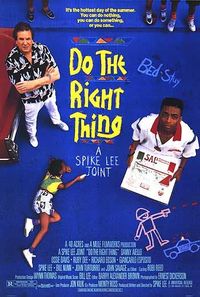
Remember, folks - always do the right thing


If there’s one film I know inside out, back to front, and upside down, it is Spike Lee’s Do the Right Thing. It’s a film I’ve watched many times. Spike Lee directed, wrote, produced, and starred in the film. It’s a film about a day in the life of a neighbourhood called Beford-Stuyvesant (known as Bed-Stuy) in Brooklyn, New York city. It’s a black neighbourhood, and race is a central theme of the film. The action is a montage of scenes in the life of the neighbourhood, all of which take place on an extremely hot summer’s day. With the oppressive heat as a backdrop, tension builds up within the community as the day unfolds, and the pressure leads to an explosion of action at the end of the film.

The film opens with footage of Rosie Perez doing some provocative, assertive dancing to the beat of Public Enemy’s Fight the Power, from their album Fear of a Black Planet. I used to love Public Enemy when I was a youngster – still do, I suppose. I’m a big fan of Spike Lee as well. I actually wrote my undergraduate dissertation on Spike Lee’s films. It wasn’t much of a dissertation to be honest – my supervisor called me an ‘underachiever’, which was pretty accurate.

A lot of the action in Do the Right Thing centres on an Italian-American business in the heart of the black community. Spike Lee’s himself plays the protagonist, Mookie, who delivers pizza’s for ‘Sal’s Famous Pizzeria’. Sal has a ‘Wall of Fame’ in the pizzeria made up of photographs of prominent Italian-Americans such as Al Pacino. One of the locals (called ‘Buggin’ Out’) takes exception to this, and demands some photos of African-Americans be put up on the wall. This leads to a series of confrontations that drive the action.

Giancarlo Esposito


Buggin’ Out is played by one of my own favourite actors, Giancarlo Esposito. He’s one of those guys who you’d recognise but probably couldn’t have identified if I hadn’t put a photo of him into this post. Off the top of my head, he’s also played Muhammed Ali’s dad in Ali (with Will Smith), and a cop in The Usual Suspects, but he’s been in loads of other stuff, usually playing character roles. He’s also been in a number of Spike Lee films. For my money, he’s one of the most versatile actors around these days. He’s played some hugely diverse roles in his career.

For me, the strength of Do the Right Thing is in its willingness to tackle identity politics head-on. I reckon it gives a very convincing picture of the complexity and diversity of racial issues, but I’m not going to try and capture that at the moment – to do justice to the film and the subject, I’d have to put a bit more time into it than I’ve got just now…

I will just say that the film partly represents a conflict between the philosophies of Martin Luther King Jr. and Malcolm X, two prominent African-American leaders who were assassinated during the 1960s. Whereas Dr. King advocated non-violence, Malcolm X asserted the right of African-Americans in the US to rely on self-help to defend themselves against brutality. The film ends with a quote from each man, outlining his own take on whether the use of force is ever justified. Dr. King’s take on things was that violence is “immoral and impractical” as a solution, as it breeds hatred, and ensures that the cycle of violence will continue. The Malcolm X quote refers to who had the power in US society, bringing us back to the Public Enemy song that features so prominently in the film. Malcolm X believed that the problem of racism was so urgent and so systematic in the US that the black community should employ any means that were necessary to bring it to an end. Spike Lee juxtaposes these competing understandings, and challenges the viewer to reconcile them with the practical realities of Do the Right Thing.

I know exactly what side I’m on. I’ve read Malcolm X’s Autobiography three times and I find his take on things pretty compelling. I think this film is actually what brought me into contact with Malcolm X’s life and thought. I’m no pacifist, and I agree with Malcolm X that for black Americans, when the US government consistently failed to do enough to protect them, self-defence should not be described as ‘violence’ but as ‘intelligence’. Malcolm X spoke in the context of a US where white supremacist attacks on African-Americans went unpunished. This was a culture of impunity for the death of 4 black girls in the bombing of a Birmingham church, and for the assassination of Medgar Evers, an official of the NAACP (National Association for the Advancement of Coloured People). Evers was immortalised in Bob Dylan’s Only a Pawn in their Game, and his assassin was only convicted in 1994 because he boasted of the murder at a KKK rally.

Do the Right Thing also stars Ossie Davis, the man who gave the eulogy at Malcolm X’s funeral, and one thing he said strikes me as quite important at this stage. He draws attention to the fact that Malcolm X had never been personally involved in any violence or disturbance. It was only a case of articulating a policy of self-reliance for a community who were the constant victim of savage attack. It seems reasonable in this context that they would take action to protect themselves and their communities.

Anyway, I got a DVD copy of Do the Right Thing at Christmas, and I’ve just watched the first 40 minutes or so of it. I’ve interrupted my viewing because I promised myself I’d try and improve my blogging frequency in 2007. Anyway, it’s a beautifully shot film, which is given a reflective edge by a lot of long takes and a pleasant jazz score by Spike’s dad, Bill Lee. In other places it becomes much more confrontational, such as in a famous scene (reprised somewhat in Lee’s The 25th Hour). A number of characters take turns addressing the camera with a string of targeted racial abuse. In turn, Puerto Rican, Italian, black, Korean and other characters vent a string of racial invectives against different groups such as Jews or Asians, such as John Turtorro’s rant against blacks which begins: “You gold-teeth, gold-chain wearing, fried chicken and biscuit-eating, monkey-ape-baboon” etc.

It’s an ensemble piece, with a lot of small roles by actors who have since become pretty well known, such as Jon Savage, Samuel L Jackson and Martin Lawrence. A lot of people reckon that all of Spike Lee’s films are about race, which is refuted by films like Summer of Sam and recently, Inside Man. He's a gifted filmmaker and shouldn't be reduced to nothing but an idealogue. But Do the Right Thing certainly has race up front and centre, and gets my vote as one of the best cinematic reflections on racial politics ever made.

Saturday, November 18, 2006

Billy Bragg gig, Vicar St. - June 3rd

Earlier this year, on June 3rd, I went to see Mr. Billy Bragg in concert for the first time. I was first introduced to his music by my girlfriend, who has been a Billy Bragg fan for many moons. She bought me one of CDs a couple of years ago, and I was immediately hooked by the first few lines of Sexuality:

I’ve had relations
With girls of many nations
I’ve made passes
At women of all classes
But just because you’re gay
I won’t turn you away
If you stick around
I’m sure that we can find some common ground

The guy is a protest singer really. In the 1980s he was involved in the collective of popular musicians called Red Wedge, which tried to get the young people of Britain to engage with politics in general and the Labour Party in particular. Red Wedge was formally disbanded in 1990, but Bragg stayed political. He has a catalogue of songs about love, life, war, and this kind of stuff - these days he seems to be mostly targeting fascism through his music with the rise of the British National Front, as well as war, racism, sexism, homophobia, etc.


The Diggers song is a good example of the kind of stuff that he sings about, and it’s particularly close to my heart, because it’s about a load of activists in the 1600s who tried to reclaim land for communal ownership. It resonates with me because I’m involved with a network in Dublin City who have set up a couple of community gardens where we grow food and link in to the local community. Here’s some Digger lyrics (the song’s actually called World Turned Upside Down):

'We come in peace' they said
'To dig and sow
We come to work the land in common
And to make the waste land grow

The sin of property
We do disdain
No one has any right to buy and sell
The earth for private gain’


From the men of property
The orders came
They sent the hired men and troopers
To wipe out the Diggers' claim
Tear down their cottages
Destroy their corn
They were dispersed
But still the vision lingers on

Bragg’s music is guitar driven stuff. I think Bragg sees himself as a punk musician, and there’s certainly some spikiness in the guitar. But it’s pretty melodic - maybe power pop would be appropriate? Anyway, I’m not too hung up on categorisation of music. It’s too easy to get bogged down in that kind of stuff.

Bragg was joined on stage for some of the tracks on keyboards by Ian McLagan, formerly of the Small Faces and the Faces. They even had a Hammond Organ. The highlight of the night might just have been a rendition of the classic Booker T and the MGs track Green Onions. (To digress, two of the MGs were Donald ‘Duck’ Dunn and Steve Cropper, and these guys have serious credibility. They were part of Dan Ackroyd and John Belushi’s touring Blues Brothers band, and can be seen in The Blues Brothers movie. They had previously been session men at Stax Studios - Booker T and the MGs were the house band , and played on some of the classic records that came out of there. Cropper was a co-writer of some incredible songs, including Sitting on the Dock of the Bay with Otis Redding, Sailing with Rod Stewart, and In the Midnight Hour with Wilson Pickett.) Bragg said that Green Onions, though instrumental, was a major political statement, being recorded in a studio in the racially segregated south by a racially integrated band.

Booker T & the MGs - revolutionaries!?


This might have been the most interesting thing he said, but Mr. Bragg talks a lot in concert. In fact, he could fairly be described as an incorrigible spoofer. He was heckled a number of times for talking too much. I don’t think he played two songs in a row throughout the whole show (except in the encore). And he wasn’t even rallying the crowd with any kind of political stuff - he was just yapping about funny stories and this kind of thing. It would have been far better if he had played a few batches of songs and chattered in between these. But he let loose in the encore, and lashed through some of his early hits.

I really enjoyed the show, but I was only familiar with a handful of the tunes. It was one of those gigs which seemed to be full of die-hard fans who knew each and every lyric “like it was written in their soul”, to paraphrase Mr. Zimmerman. Anyway, that’s enough about that.

Friday, June 02, 2006

Fattening Frogs? What?

The title Fattening Frogs for Snakes refers to a song by the great blues harmonica player, Sonny Boy Williamson II.


Sonny Boy Williamson II


Sonny Boy Williamson II was one of the key figures in the history of the blues. He was born Rice Miller, but stole the name Sonny Boy Williamson from another harp player of the time ('blues harp' or just plain 'harp'=blues slang term for harmonica). They are now known respectively as Sonny Boy Williamson I and II. It is a reasonably regular moniker, in a musical genre characterised by lots of strange names. Some of my favourite blues names off the top of my head include Pinetop Perkins, Blind Lemon Jefferson, Lightnin’ Slim and Taj Mahal (who I managed to see live with his Phantom Blues Band - brilliant stuff).

Like many other of the great blues icons, there is a certain amount of confusion about when Sonny Boy II was born. I have even heard that he lied about the year of his birth in order to get the drop on Sonny Boy I in his claim to the name. Sonny Boy II was from Mississippi, and was a virtuoso on the harp. It’s rumoured that he could play with no hands, by inserting the entire harmonica into his mouth or holding it between his top lip and his nose.

One thing that’s interesting about old-time blues lyrics is the way it seems to be the men that are persecuted rather than the women. Blues songs are populated by women who walk all over the long suffering bluesmen, going out late and not coming back home, spending all their man's money, and evicting them from their own homes in the freezing cold (see the Sonny Boy Williamson II track ‘Nine Below Zero’). A good example of this is Sonny Boy’s classic song, ‘Help Me’, which has become a harmonica standard, in which he pleads for help with the housework (seriously):

I may have to wash
I may have to sew
I may have to cook
I might mop the floor
But you help me babe
I can’t do it all by myself
You know if you don't help me darling
I'll find myself somebody else

I was in Bruxelles once when the Mary Stokes Band was playing, and I was very proud of myself when they agreed to play a request of ‘Help Me’. They had just rejected another couple of calls for requests, but I obviously fooled them into thinking I was a blues purist. Then they proceeded to blow me away with a great version of the song. They had the last laugh when I bought their CD.

The song title ‘Fattening Frogs for Snakes’ seemingly refers to an old American proverb about putting loads of energy into something and not reaping the benefits. If you spend ages fattening up a frog with lots of delicacies, and then a big snake slips into his cage and eats him, you’ve pretty much wasted loads of your time and effort. If I had a penny for every frog I lost this way...

My research on Google tells me that ‘Fattening Frogs For Snakes’ was used as the title of a book about the old blues musicians by a fellow called John Sinclair. He compares the years of musical craftsmanship of the Delta blues musicians to fattening frogs for snakes. According to his take on things, these (mostly African American) blues men and women spent years honing their craft, and then suddenly all these white musicians swooped in in the 60s and had huge success by appropriating blues music.

So, the fatted frog was eaten by the snake-like new wave of British musicians – people such as Eric Clapton, John Mayall, The Animals and The Rolling Stones. There’s no doubt that these guys are true fans of the blues, but they did make it big by ripping off the blues stylings of pioneers like Muddy Waters, Chuck Berry and Howlin’ Wolf. Lots of these guys died in misery and poverty (although there are plenty more like BB King who got plenty of recognition).

Anyway, that’s the source of my blog title - just in case it seemed a little esoteric…