
For the past 21 days, Israel has been attacking the Gaza strip, ostensibly targeting the Islamist group HAMAS, but in actuality mainly killing shitloads of civilians. 30% of the Palestinian dead are women and children. According to figures cited by Reuters around 20 minutes ago, 13 Israelis had been killed (10 of them soldiers) and over 1,055 Palestinians were killed, 670 of whom were civilians. (I hope you've heard about this conflict by now...)
Given the current set up of the world, there's not much that's going to be done about Israel's current attack on Gaza. Israel is just being Israel, and with the exception of the US, they're not going to be influenced by anybody to stop what they're doing. But nonetheless, it's refreshing to see some kind of concrete action by the governments of Bolivia and Venezuela against Israel. Both governments cut all diplomatic ties with the Israelis, with the Venezuelans expelling the Israeli ambassador and embassy staff, and the Bolivians calling on the International Criminal Court to bring human rights abuse charges against Israel.
Showing posts with label politics. Show all posts
Showing posts with label politics. Show all posts
Friday, January 16, 2009

Thursday, September 04, 2008
Orwellian reading
I recently finished George Orwell's Coming Up For Air, which I bought on the street in Syria for about €0.70. Good to get back to some Orwell. He's one of my favourite writers, to the extent that I can say that he has had a formative effect on my thinking. I would recommend anyone to check out some of his essays, such as 'Politics and the English Language', which are available online. I love his simple, clear writing style. He seems to really hold to the belief that you shouldn't use a big word where a smaller word will do, and that sentences should be short. A big problem with a lot of writing - and particularly academic writing, I'd hazard - is that people like to use very complicated sentence structures. Clarity suffers as a result.

Coming Up For Air is the story of 45-year-old George Bowling, a man who is pissed off with his lot. It is set in the run-up to World War II. Bowling has a wife and family and a job that is unexciting, and he goes back to his village of origin to try to capture something about himself. However, the trip is entirely disillusioning and deflating because his village has been swallowed up by the march of the urban.
The book has been referenced as a forerunner to 1984, and I can see the similarity, although the society depicted in Coming Up For Air is less extreme and the story less intense. Politics are to the forefront however, and the novel deals with a newly emerged middle class of sorts in inter-war England, evoking the misery and defeat of the capitulation to wage slavery. This is my take on it, at least. There isn't really much hopeful coming out of the narrative that I can recall. But maybe there's some hope in the protagonist's vague realisation (which is far from epiphany) that the human experience contains the potential for a more meaningful existence. So there is hope but not redemption methinks.
World War II looms large over the plot, and Bowling's memories of his service in World War I colour his pessimism and apathy.
Listening to Charles Mingus Fables of Faubus in my favourite cafe... Beautiful.

Eric Blair aka George McOrwell
Coming Up For Air is the story of 45-year-old George Bowling, a man who is pissed off with his lot. It is set in the run-up to World War II. Bowling has a wife and family and a job that is unexciting, and he goes back to his village of origin to try to capture something about himself. However, the trip is entirely disillusioning and deflating because his village has been swallowed up by the march of the urban.
The book has been referenced as a forerunner to 1984, and I can see the similarity, although the society depicted in Coming Up For Air is less extreme and the story less intense. Politics are to the forefront however, and the novel deals with a newly emerged middle class of sorts in inter-war England, evoking the misery and defeat of the capitulation to wage slavery. This is my take on it, at least. There isn't really much hopeful coming out of the narrative that I can recall. But maybe there's some hope in the protagonist's vague realisation (which is far from epiphany) that the human experience contains the potential for a more meaningful existence. So there is hope but not redemption methinks.
World War II looms large over the plot, and Bowling's memories of his service in World War I colour his pessimism and apathy.
Listening to Charles Mingus Fables of Faubus in my favourite cafe... Beautiful.
Thursday, July 05, 2007
Some of the best news I've heard all year
After 16 weeks in detention, the BBC's Gaza correspondent Alan Johnston has been released from detention by his kidnappers. The journalist was released as a result of negotiations between the Palestinian Hamas, who are in control of the Gaza Strip, and his captors, another Palestinian Islamist movement called 'the Army of Islam'.

In my view, Hamas form the bulk of the legitimate government of Palestine (although there is no Palestinian state). They had a decisive victory in elections in January 2006. The EU declared these elections to be free and fair. Hamas went on to form a national unity government with Fatah in March 2007.
However, despite all of this, the so-called 'international community' has refused to deal with Hamas. The EU, the US, and Israel all favour Mahmoud Abbas of Fatah, who was the Palestinian President, and have marginalised Ismail Haniyeh of Hamas, who was the Palestinian Prime Minister. The political system in Palestine is semi-presidentialism, whereby power is divided between a president and a prime minister who is answerable to a parliamentary assembly. A friend and fellow blogger is writing his thesis on semi-presidentialism in Palestine.
In any case, this fragile set-up between Hamas and Fatah continued for a while despite the fact that many powerful external actors would only speak to Fatah's Mahmoud Abbas, instead of dealing with the government as a whole. Indeed, Israel attempted to blow up Hamas members of government in the Gaza Strip at every opportunity. Eventually, relations between these partners in the Palestinian government have broken down.

The current situation is that, following fighting between Hamas and Fatah, Hamas have now taken control of the Gaza Strip and Fatah are in control of the West Bank. As can be seen from the map, both territories are entirely separate (although the map does not show the extent to which Israel has encroached into the West Bank so that it has now shrunk significantly in size). Mahmoud Abbas has declared that Haniyeh is dismissed as Prime Minister, but Haniyeh and his Hamas colleagues have refused to accept this. But there is an evident consensus throughout much of the mainstream media and the major actors of the international political establishment that it is Fatah who are legitimate. Abbas is still recognised as the Palestinian President, whereas Haniyeh is described as a terrorist.

This is the background to Johnston's release. Having taken over Gaza, Hamas are probably hoping that they will gain some credit for freeing Johnston. But they surely realise that the situation is unlikely to change to any significant extent. The main external players with regard to the issue of Palestine are known as the quartet: the US, the EU, the UN and Russia. Although Russia has made some attempts to gain more recognition for the Hamas government, the other three legs of the quartet are steadfastly anti-Hamas. This amounts to backing up Israel's position.
As I said, for me Hamas are the legitimate representatives of the Palestinians. Despite the fact that I have plenty of problems with the group, I reckon that the only practical, rational course of action to any man, woman or child in the occupied Palestinian territories (particularly in Gaza) is to support Hamas. But I reckon that Hamas will continue to be isolated, despite a BBC report suggesting that there may be the potential for a change in attitudes to Hamas - but then, I tend to be pretty pessimistic about these things.
The Army of Islam group that had been holding Johnston is also one of the groups responsible for the kidnap of Israeli soldier Gilad Shalit in June 2006. It was following Shalit's kidnapping that Israel intensified its targeting of Hamas - an Israeli helicopter fired two rockets into the home of Ismail Haniyeh a week later. The fate of this young soldier is a key issue for Israel. It is awful to think of the 19 year old soldier - who was injured during the kidnapping - being held by kidnappers for over a year. However, at least he was a military target, whereas Alan Johnston is a civilian. Meanwhile, about 800 Palestinians are being held in Israeli 'administrative detention' - in other words, being held without being charged with any crime.

Certainly the Israel state considers itself at war with Hamas - in yet another of its frequent extrajudicial executions, Israel killed at least six Hamas members the night after Johnston's release. Yet one of its three stated reasons for refusing to deal with Hamas is that Hamas refuses to renounce violence. The mind boggles...

Free at last
In my view, Hamas form the bulk of the legitimate government of Palestine (although there is no Palestinian state). They had a decisive victory in elections in January 2006. The EU declared these elections to be free and fair. Hamas went on to form a national unity government with Fatah in March 2007.
However, despite all of this, the so-called 'international community' has refused to deal with Hamas. The EU, the US, and Israel all favour Mahmoud Abbas of Fatah, who was the Palestinian President, and have marginalised Ismail Haniyeh of Hamas, who was the Palestinian Prime Minister. The political system in Palestine is semi-presidentialism, whereby power is divided between a president and a prime minister who is answerable to a parliamentary assembly. A friend and fellow blogger is writing his thesis on semi-presidentialism in Palestine.
In any case, this fragile set-up between Hamas and Fatah continued for a while despite the fact that many powerful external actors would only speak to Fatah's Mahmoud Abbas, instead of dealing with the government as a whole. Indeed, Israel attempted to blow up Hamas members of government in the Gaza Strip at every opportunity. Eventually, relations between these partners in the Palestinian government have broken down.

Hamas politician Khalil al-Hayya
Israel bombed his home, killing his wife and six of his family
The current situation is that, following fighting between Hamas and Fatah, Hamas have now taken control of the Gaza Strip and Fatah are in control of the West Bank. As can be seen from the map, both territories are entirely separate (although the map does not show the extent to which Israel has encroached into the West Bank so that it has now shrunk significantly in size). Mahmoud Abbas has declared that Haniyeh is dismissed as Prime Minister, but Haniyeh and his Hamas colleagues have refused to accept this. But there is an evident consensus throughout much of the mainstream media and the major actors of the international political establishment that it is Fatah who are legitimate. Abbas is still recognised as the Palestinian President, whereas Haniyeh is described as a terrorist.

This is the background to Johnston's release. Having taken over Gaza, Hamas are probably hoping that they will gain some credit for freeing Johnston. But they surely realise that the situation is unlikely to change to any significant extent. The main external players with regard to the issue of Palestine are known as the quartet: the US, the EU, the UN and Russia. Although Russia has made some attempts to gain more recognition for the Hamas government, the other three legs of the quartet are steadfastly anti-Hamas. This amounts to backing up Israel's position.
As I said, for me Hamas are the legitimate representatives of the Palestinians. Despite the fact that I have plenty of problems with the group, I reckon that the only practical, rational course of action to any man, woman or child in the occupied Palestinian territories (particularly in Gaza) is to support Hamas. But I reckon that Hamas will continue to be isolated, despite a BBC report suggesting that there may be the potential for a change in attitudes to Hamas - but then, I tend to be pretty pessimistic about these things.
The Army of Islam group that had been holding Johnston is also one of the groups responsible for the kidnap of Israeli soldier Gilad Shalit in June 2006. It was following Shalit's kidnapping that Israel intensified its targeting of Hamas - an Israeli helicopter fired two rockets into the home of Ismail Haniyeh a week later. The fate of this young soldier is a key issue for Israel. It is awful to think of the 19 year old soldier - who was injured during the kidnapping - being held by kidnappers for over a year. However, at least he was a military target, whereas Alan Johnston is a civilian. Meanwhile, about 800 Palestinians are being held in Israeli 'administrative detention' - in other words, being held without being charged with any crime.

The young Israeli hostage Gilad Shalit
Certainly the Israel state considers itself at war with Hamas - in yet another of its frequent extrajudicial executions, Israel killed at least six Hamas members the night after Johnston's release. Yet one of its three stated reasons for refusing to deal with Hamas is that Hamas refuses to renounce violence. The mind boggles...
Saturday, June 16, 2007
The CIA and Shannon airport
My friend Ian has noted that it is disturbing how little media attention is on the current extraordinary rendition case being heard in Italy. Extraordinary rendition is the process whereby the CIA kidnaps people, and detains them extrajudicially. These people are often subject to torture. It really is that stark. The US is having people abducted from the streets of EU constitutional democracies without the knowledge of the domestic governments, and subsequently tortured.
I just want to note an Irish connection in this issue. Last summer, the Council of Europe rapporteur, Dick Marty, included Ireland's Shannon airport in a map of "secret detentions and unlawful inter-state transfers". The Irish government response is basically to say that they trust the Americans and everything will be grand. Irish Foreign Affairs minister Dermot Ahern accepted the assurances of Condoleeza Rice that Shannon was not used as a transit point for the CIA's abductees.

In February of this year, the European Parliament rejected Dermot Ahern's position and called for a Dáil inquiry into Ireland's role in instances of extraordinary rendition. In 2005, Amnesty International reported that 800 secret CIA flights had used European airspace, and noted evidence about specific flights in which Shannon airport was used as a stopover.
I just want to note an Irish connection in this issue. Last summer, the Council of Europe rapporteur, Dick Marty, included Ireland's Shannon airport in a map of "secret detentions and unlawful inter-state transfers". The Irish government response is basically to say that they trust the Americans and everything will be grand. Irish Foreign Affairs minister Dermot Ahern accepted the assurances of Condoleeza Rice that Shannon was not used as a transit point for the CIA's abductees.
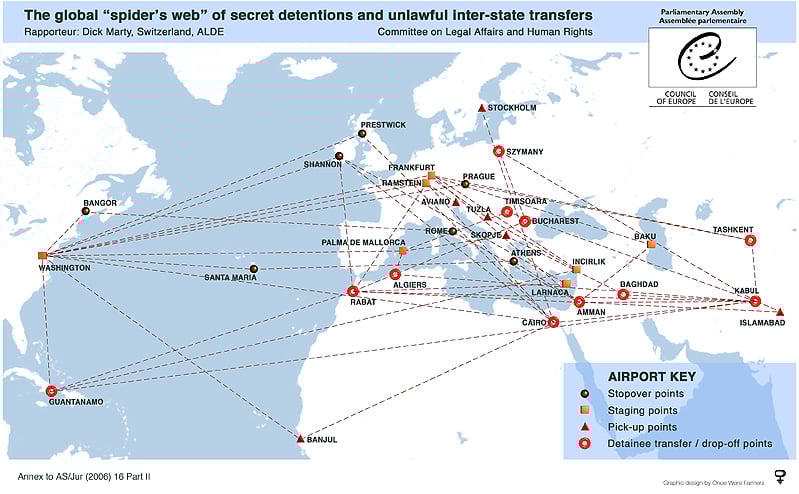

In February of this year, the European Parliament rejected Dermot Ahern's position and called for a Dáil inquiry into Ireland's role in instances of extraordinary rendition. In 2005, Amnesty International reported that 800 secret CIA flights had used European airspace, and noted evidence about specific flights in which Shannon airport was used as a stopover.
Friday, April 13, 2007
Another one bites the dust
Another essay falls before the might of my academic endeavours!! Just handed in my first assignment of the semester. The task was based around an imaginary scenario in North Africa. We had to imagine that there were upcoming negotiations on reform of the constitution, and each student had to give advice to one of the various delegations to the conference. I had to write a policy brief advising the nationalist and conservative party of Morocco, Istiqlal. The other participants included the EU, the socialists, the hardcore Islamists, the more moderate Islamists, and last but not least, the top dog and key holder of political power, the defender of the faith, and personal owner of 60% of all the shares on Morocco's stock exchange, ladies and gentlemen, please give it up for his majesty the king, Mohamed VI!!! (known as M6 to his buddies).

It seems to me that the king would only agree to democratisation to the extent that it makes his rule look more legitimate. Although there is an elected parliament in Morocco, most of the power rests outside this system. The government's decision-making powers are constrained by the fact that many other members of parliament are indirectly appointed, and the key ministries are given to confidants of the king who may not even be a member of a political party. Indeed, the current prime minister, Driss Jettou, isn't in any party. So I reckon that M6 would like to throw in some superficial reforms to make it look like he is liberalising, without actually devolving meaningful power outside of the palace.
The increasing popularity of the Islamist movements are putting pressure on the more established political actors in Morocco, so I'm confident that my nationalist/conservative colleagues can do a deal with the king to gain some power and marginalise the Islamists.
Great to get one assignment out of the way. As usual, I was up all night last night putting on the finishing touches. I didn't get to bed till after 0600. And the next deadline is just three days away!! But it's all under control. I've done plenty of groundwork for this next one during the week. Roll on Monday...

King Mohamed VI
It seems to me that the king would only agree to democratisation to the extent that it makes his rule look more legitimate. Although there is an elected parliament in Morocco, most of the power rests outside this system. The government's decision-making powers are constrained by the fact that many other members of parliament are indirectly appointed, and the key ministries are given to confidants of the king who may not even be a member of a political party. Indeed, the current prime minister, Driss Jettou, isn't in any party. So I reckon that M6 would like to throw in some superficial reforms to make it look like he is liberalising, without actually devolving meaningful power outside of the palace.
The increasing popularity of the Islamist movements are putting pressure on the more established political actors in Morocco, so I'm confident that my nationalist/conservative colleagues can do a deal with the king to gain some power and marginalise the Islamists.
Great to get one assignment out of the way. As usual, I was up all night last night putting on the finishing touches. I didn't get to bed till after 0600. And the next deadline is just three days away!! But it's all under control. I've done plenty of groundwork for this next one during the week. Roll on Monday...
Monday, March 05, 2007
Cab Calloway chooses music over the Harlem Globetrotters
This YouTube thing is addictive. Just found a very short clip of the great basketball player Kareem Abdul-Jabbar talking about music legend Cab Calloway. It seems that Calloway was actually a pro basketball player after playing bball in high school. In the 1920s, he was selected to play with the Harlem Globetrotters, but decided instead to tour with his band. He also played baseball against Dizzy Gillespie - the great jazz trumpeter.
Kareem Abdul-Jabbar won a national championship in college and then went on to win 6 NBA championships for two teams, and played professionally for 20 YEARS!!! He also was one of the pilots in the film Airplane, and fought against Bruce Lee in Game of Death. He was born as Lew Alcindor, but changed his name because of his conversion to Islam. Advice from fellow students from Muslim countries led to his avoiding the US Black Muslim movement, the Nation of Islam, whose ranks had once included Malcolm X. In this interview, Abdul-Jabbar talks about what he calls the "totalitarian" version of Islam that underpinned the September the 11th attacks.
20-July-2007: I've just noticed that YouTube have removed this video due to an alleged violation of its terms of use. Not sure what that's about...
Sunday, March 04, 2007
Independent news from African-American Los Angeles
After covering a story down the street, a Hood News reporter shoots footage of the LAPD shooting at a homeless man who was running away from them. The police tried to stop Hood News from filming and argued with the reporter.
I came across this after watching a message from the stars of the NBA to the youth of the urban ghettos of the US. A few black basketball stars who had grown up in the hood had some words for these African-American communities. In this other Hood News video, the crew also try to interview the young star LeBron James and are snubbed. The crew dismiss James as 'Hollywood' when he refuses an interview. The reporter said that James was refusing to address a "community in poverty, and up and coming youth" as LeBron James stood behind him, and then called to James to give a shout out on Hood News, but was totally ignored as James got into his car. The reporter reckoned he was on a "solo mission" and it was "a disappointment to the black culture, and minorities". See also details of LeBron's dance-off defeat, below.
Saturday, February 24, 2007
Ireland v England rugby
I'm pretty much a one-sport guy, and that's basketball. I don't often watch other sports on television. Although I watch Irish soccer internationals, I am not a fan of soccer or rugby, and I seldom watch Gaelic football or hurling. But I've just watched Ireland play rugby against England in Croke Park. In England's first game in Croke Park, they lost to Ireland by their biggest margin ever. The final score was 43-13. Ireland played some very skilful rugby, including a GAA-like kick and catch for Ireland's third (I think) try. Ronan O'Gara didn't miss a kick at goal.

Before the game, there was a lot of focus on political issues surrounding Ireland's colonial history. In 1920, the British army killed 14 civilians in the very stadium where the game would be played (as al-Jazeera also reported). For decades, the Irish GAA (Gaelic Athletic Association) have forbidden English sports (known as 'garrison games') from being played at Croke Park. This afternoon, as my friend Kealan noted on his blog, England's team and supporters sang God Save the Queen in Croker before the game, before going on to suffer a decisive defeat.

An interesting mix of sports, culture, and politics this afternoon at Croke Park, which I can actually see from the window of my house...

Stringer against France a few years ago
Before the game, there was a lot of focus on political issues surrounding Ireland's colonial history. In 1920, the British army killed 14 civilians in the very stadium where the game would be played (as al-Jazeera also reported). For decades, the Irish GAA (Gaelic Athletic Association) have forbidden English sports (known as 'garrison games') from being played at Croke Park. This afternoon, as my friend Kealan noted on his blog, England's team and supporters sang God Save the Queen in Croker before the game, before going on to suffer a decisive defeat.

Croke Park
An interesting mix of sports, culture, and politics this afternoon at Croke Park, which I can actually see from the window of my house...
Sunday, January 21, 2007
Remember, folks - always do the right thing

If there’s one film I know inside out, back to front, and upside down, it is Spike Lee’s Do the Right Thing. It’s a film I’ve watched many times. Spike Lee directed, wrote, produced, and starred in the film. It’s a film about a day in the life of a neighbourhood called Beford-Stuyvesant (known as Bed-Stuy) in Brooklyn, New York city. It’s a black neighbourhood, and race is a central theme of the film. The action is a montage of scenes in the life of the neighbourhood, all of which take place on an extremely hot summer’s day. With the oppressive heat as a backdrop, tension builds up within the community as the day unfolds, and the pressure leads to an explosion of action at the end of the film.
The film opens with footage of Rosie Perez doing some provocative, assertive dancing to the beat of Public Enemy’s Fight the Power, from their album Fear of a Black Planet. I used to love Public Enemy when I was a youngster – still do, I suppose. I’m a big fan of Spike Lee as well. I actually wrote my undergraduate dissertation on Spike Lee’s films. It wasn’t much of a dissertation to be honest – my supervisor called me an ‘underachiever’, which was pretty accurate.
A lot of the action in Do the Right Thing centres on an Italian-American business in the heart of the black community. Spike Lee’s himself plays the protagonist, Mookie, who delivers pizza’s for ‘Sal’s Famous Pizzeria’. Sal has a ‘Wall of Fame’ in the pizzeria made up of photographs of prominent Italian-Americans such as Al Pacino. One of the locals (called ‘Buggin’ Out’) takes exception to this, and demands some photos of African-Americans be put up on the wall. This leads to a series of confrontations that drive the action.

Giancarlo Esposito
Buggin’ Out is played by one of my own favourite actors, Giancarlo Esposito. He’s one of those guys who you’d recognise but probably couldn’t have identified if I hadn’t put a photo of him into this post. Off the top of my head, he’s also played Muhammed Ali’s dad in Ali (with Will Smith), and a cop in The Usual Suspects, but he’s been in loads of other stuff, usually playing character roles. He’s also been in a number of Spike Lee films. For my money, he’s one of the most versatile actors around these days. He’s played some hugely diverse roles in his career.
For me, the strength of Do the Right Thing is in its willingness to tackle identity politics head-on. I reckon it gives a very convincing picture of the complexity and diversity of racial issues, but I’m not going to try and capture that at the moment – to do justice to the film and the subject, I’d have to put a bit more time into it than I’ve got just now…
 I will just say that the film partly represents a conflict between the philosophies of Martin Luther King Jr. and Malcolm X, two prominent African-American leaders who were assassinated during the 1960s. Whereas Dr. King advocated non-violence, Malcolm X asserted the right of African-Americans in the US to rely on self-help to defend themselves against brutality. The film ends with a quote from each man, outlining his own take on whether the use of force is ever justified. Dr. King’s take on things was that violence is “immoral and impractical” as a solution, as it breeds hatred, and ensures that the cycle of violence will continue. The Malcolm X quote refers to who had the power in US society, bringing us back to the Public Enemy song that features so prominently in the film. Malcolm X believed that the problem of racism was so urgent and so systematic in the US that the black community should employ any means that were necessary to bring it to an end. Spike Lee juxtaposes these competing understandings, and challenges the viewer to reconcile them with the practical realities of Do the Right Thing.
I know exactly what side I’m on. I’ve read Malcolm X’s Autobiography three times and I find his take on things pretty compelling. I think this film is actually what brought me into contact with Malcolm X’s life and thought. I’m no pacifist, and I agree with Malcolm X that for black Americans, when the US government consistently failed to do enough to protect them, self-defence should not be described as ‘violence’ but as ‘intelligence’. Malcolm X spoke in the context of a US where white supremacist attacks on African-Americans went unpunished. This was a culture of impunity for the death of 4 black girls in the bombing of a Birmingham church, and for the assassination of Medgar Evers, an official of the NAACP (National Association for the Advancement of Coloured People). Evers was immortalised in Bob Dylan’s Only a Pawn in their Game, and his assassin was only convicted in 1994 because he boasted of the murder at a KKK rally.
Do the Right Thing also stars Ossie Davis, the man who gave the eulogy at Malcolm X’s funeral, and one thing he said strikes me as quite important at this stage. He draws attention to the fact that Malcolm X had never been personally involved in any violence or disturbance. It was only a case of articulating a policy of self-reliance for a community who were the constant victim of savage attack. It seems reasonable in this context that they would take action to protect themselves and their communities.
Anyway, I got a DVD copy of Do the Right Thing at Christmas, and I’ve just watched the first 40 minutes or so of it. I’ve interrupted my viewing because I promised myself I’d try and improve my blogging frequency in 2007. Anyway, it’s a beautifully shot film, which is given a reflective edge by a lot of long takes and a pleasant jazz score by Spike’s dad, Bill Lee. In other places it becomes much more confrontational, such as in a famous scene (reprised somewhat in Lee’s The 25th Hour). A number of characters take turns addressing the camera with a string of targeted racial abuse. In turn, Puerto Rican, Italian, black, Korean and other characters vent a string of racial invectives against different groups such as Jews or Asians, such as John Turtorro’s rant against blacks which begins: “You gold-teeth, gold-chain wearing, fried chicken and biscuit-eating, monkey-ape-baboon” etc.
It’s an ensemble piece, with a lot of small roles by actors who have since become pretty well known, such as Jon Savage, Samuel L Jackson and Martin Lawrence. A lot of people reckon that all of Spike Lee’s films are about race, which is refuted by films like Summer of Sam and recently, Inside Man. He's a gifted filmmaker and shouldn't be reduced to nothing but an idealogue. But Do the Right Thing certainly has race up front and centre, and gets my vote as one of the best cinematic reflections on racial politics ever made.
Saturday, November 18, 2006
Billy Bragg gig, Vicar St. - June 3rd
Earlier this year, on June 3rd, I went to see Mr. Billy Bragg in concert for the first time. I was first introduced to his music by my girlfriend, who has been a Billy Bragg fan for many moons. She bought me one of CDs a couple of years ago, and I was immediately hooked by the first few lines of Sexuality:
The guy is a protest singer really. In the 1980s he was involved in the collective of popular musicians called Red Wedge, which tried to get the young people of Britain to engage with politics in general and the Labour Party in particular. Red Wedge was formally disbanded in 1990, but Bragg stayed political. He has a catalogue of songs about love, life, war, and this kind of stuff - these days he seems to be mostly targeting fascism through his music with the rise of the British National Front, as well as war, racism, sexism, homophobia, etc.

The Diggers song is a good example of the kind of stuff that he sings about, and it’s particularly close to my heart, because it’s about a load of activists in the 1600s who tried to reclaim land for communal ownership. It resonates with me because I’m involved with a network in Dublin City who have set up a couple of community gardens where we grow food and link in to the local community. Here’s some Digger lyrics (the song’s actually called World Turned Upside Down):
Bragg’s music is guitar driven stuff. I think Bragg sees himself as a punk musician, and there’s certainly some spikiness in the guitar. But it’s pretty melodic - maybe power pop would be appropriate? Anyway, I’m not too hung up on categorisation of music. It’s too easy to get bogged down in that kind of stuff.
Bragg was joined on stage for some of the tracks on keyboards by Ian McLagan, formerly of the Small Faces and the Faces. They even had a Hammond Organ. The highlight of the night might just have been a rendition of the classic Booker T and the MGs track Green Onions. (To digress, two of the MGs were Donald ‘Duck’ Dunn and Steve Cropper, and these guys have serious credibility. They were part of Dan Ackroyd and John Belushi’s touring Blues Brothers band, and can be seen in The Blues Brothers movie. They had previously been session men at Stax Studios - Booker T and the MGs were the house band , and played on some of the classic records that came out of there. Cropper was a co-writer of some incredible songs, including Sitting on the Dock of the Bay with Otis Redding, Sailing with Rod Stewart, and In the Midnight Hour with Wilson Pickett.) Bragg said that Green Onions, though instrumental, was a major political statement, being recorded in a studio in the racially segregated south by a racially integrated band.

This might have been the most interesting thing he said, but Mr. Bragg talks a lot in concert. In fact, he could fairly be described as an incorrigible spoofer. He was heckled a number of times for talking too much. I don’t think he played two songs in a row throughout the whole show (except in the encore). And he wasn’t even rallying the crowd with any kind of political stuff - he was just yapping about funny stories and this kind of thing. It would have been far better if he had played a few batches of songs and chattered in between these. But he let loose in the encore, and lashed through some of his early hits.
I really enjoyed the show, but I was only familiar with a handful of the tunes. It was one of those gigs which seemed to be full of die-hard fans who knew each and every lyric “like it was written in their soul”, to paraphrase Mr. Zimmerman. Anyway, that’s enough about that.
I’ve had relations
With girls of many nations
I’ve made passes
At women of all classes
But just because you’re gay
I won’t turn you away
If you stick around
I’m sure that we can find some common ground
The guy is a protest singer really. In the 1980s he was involved in the collective of popular musicians called Red Wedge, which tried to get the young people of Britain to engage with politics in general and the Labour Party in particular. Red Wedge was formally disbanded in 1990, but Bragg stayed political. He has a catalogue of songs about love, life, war, and this kind of stuff - these days he seems to be mostly targeting fascism through his music with the rise of the British National Front, as well as war, racism, sexism, homophobia, etc.

The Diggers song is a good example of the kind of stuff that he sings about, and it’s particularly close to my heart, because it’s about a load of activists in the 1600s who tried to reclaim land for communal ownership. It resonates with me because I’m involved with a network in Dublin City who have set up a couple of community gardens where we grow food and link in to the local community. Here’s some Digger lyrics (the song’s actually called World Turned Upside Down):
'We come in peace' they said
'To dig and sow
We come to work the land in common
And to make the waste land grow
…
The sin of property
We do disdain
No one has any right to buy and sell
The earth for private gain’
…
From the men of property
The orders came
They sent the hired men and troopers
To wipe out the Diggers' claim
Tear down their cottages
Destroy their corn
They were dispersed
But still the vision lingers on
Bragg’s music is guitar driven stuff. I think Bragg sees himself as a punk musician, and there’s certainly some spikiness in the guitar. But it’s pretty melodic - maybe power pop would be appropriate? Anyway, I’m not too hung up on categorisation of music. It’s too easy to get bogged down in that kind of stuff.
Bragg was joined on stage for some of the tracks on keyboards by Ian McLagan, formerly of the Small Faces and the Faces. They even had a Hammond Organ. The highlight of the night might just have been a rendition of the classic Booker T and the MGs track Green Onions. (To digress, two of the MGs were Donald ‘Duck’ Dunn and Steve Cropper, and these guys have serious credibility. They were part of Dan Ackroyd and John Belushi’s touring Blues Brothers band, and can be seen in The Blues Brothers movie. They had previously been session men at Stax Studios - Booker T and the MGs were the house band , and played on some of the classic records that came out of there. Cropper was a co-writer of some incredible songs, including Sitting on the Dock of the Bay with Otis Redding, Sailing with Rod Stewart, and In the Midnight Hour with Wilson Pickett.) Bragg said that Green Onions, though instrumental, was a major political statement, being recorded in a studio in the racially segregated south by a racially integrated band.

Booker T & the MGs - revolutionaries!?
This might have been the most interesting thing he said, but Mr. Bragg talks a lot in concert. In fact, he could fairly be described as an incorrigible spoofer. He was heckled a number of times for talking too much. I don’t think he played two songs in a row throughout the whole show (except in the encore). And he wasn’t even rallying the crowd with any kind of political stuff - he was just yapping about funny stories and this kind of thing. It would have been far better if he had played a few batches of songs and chattered in between these. But he let loose in the encore, and lashed through some of his early hits.
I really enjoyed the show, but I was only familiar with a handful of the tunes. It was one of those gigs which seemed to be full of die-hard fans who knew each and every lyric “like it was written in their soul”, to paraphrase Mr. Zimmerman. Anyway, that’s enough about that.
Subscribe to:
Posts (Atom)